Chapter 45 — Government Macroeconomic Policy Objectives
Cambridge International AS & A Level Economics (9708) · Unit 10.1 · 4th edition coursebook
Learning objectives
- Analyse macroeconomic policy objectives that aim to maintain a low and stable rate of inflation.
- Analyse macroeconomic policy objectives that aim to achieve balance of payments stability.
- Analyse macroeconomic policy objectives that aim to keep unemployment low and of short duration.
- Analyse macroeconomic policy objectives that aim for economic growth or an increase in the economic growth rate.
- Analyse macroeconomic policy objectives that aim to achieve sustainable development.
- Analyse macroeconomic policy objectives that aim to redistribute income and wealth from the rich to people on low incomes.
Key terms
- sustainable development
- development that ensures that the needs of the present generation can be met without harming the well-being of future generations.
45.1Inflation
Governments aim for inflation to be low and stable, and a growing number of governments now set their central banks an explicit inflation target. Whether the target is met depends on factors that go beyond domestic conditions. A country imports raw materials, components and capital goods from trading partners, so inflation in those partner countries can be passed through to domestic costs of production. If alternative sources cannot be found, the country's cost-push inflation will rise. A clear example is an oil-importing country: if oil-producing countries push up the price of oil, the country's production costs rise across many industries. High inflation in rival trading partners can also reduce competitive pressure on domestic firms to keep their own price rises low.
The choice of anti-inflation policy is also constrained by what other governments and central banks are doing. A rise in income tax rates, if it is not matched abroad, may lead skilled workers to leave the country and discourage multinational companies from locating there. Raising the rate of interest above that of rival countries may attract an inflow of financial capital, which pushes the exchange rate up. The stronger currency does help reduce inflation by lowering the price of imports, but it can also reduce the international competitiveness of the country's exports. For these reasons, central bank and government officials often co-ordinate with their counterparts in other countries. Achievement of one macroeconomic objective is rarely independent of the others — performance on inflation interacts with growth, unemployment and the balance of payments at every step.
45.2Balance of payments stability
Governments usually aim for the credit items on the current account of the balance of payments to equal the debit items over the long run. A persistent deficit reduces aggregate demand and can build up external debt as the deficit is financed by borrowing from abroad. A persistent surplus, in contrast, can be inflationary because net exports add to aggregate demand, and it carries an opportunity cost: resources are devoted to producing exports rather than to imports that domestic households and firms could otherwise enjoy.
Governments also try to avoid large swings in the current account balance. Moving from a large deficit to a surplus and back again drags the exchange rate up and down with it. Frequent and unpredictable movements in the exchange rate create uncertainty for firms that are deciding whether to invest, and uncertainty depresses investment and economic growth. Stability — both in the level of the current account and in the exchange rate that goes with it — is therefore a goal in its own right, not just a by-product of other policies.
45.3Unemployment
Governments aim to keep unemployment low and any spells of unemployment short. The faster an unemployed worker returns to a job, the less output is lost, the less the government pays out in unemployment benefits and the less income the worker forgoes. Short spells of unemployment also limit the damage to a worker's skills. Long-term unemployment can leave a worker behind on training, on new technology and on changes in working practices, which makes a return to employment progressively harder. A target of low unemployment is therefore as much about preventing long durations as about reducing the headline rate.
45.4Economic growth
Governments aim for economic growth, and in particular for an increase in the growth rate when the economy is operating below capacity with a negative output gap. The standard tools are expansionary fiscal policy and expansionary monetary policy, both of which raise aggregate demand. If national output rises, unemployment is likely to fall. However, if aggregate demand increases too quickly relative to productive capacity, demand-pull inflation will result. The effect on the current account of the balance of payments is ambiguous: faster growth may lift exports, but it also pulls in more imported raw materials and capital goods, and some of the higher household incomes will be spent on imported consumer goods.
A second concern is sustainability. Higher output that comes from running down non-renewable resources, or from production methods that damage the environment, may not be sustainable. Agricultural output, for instance, can rise in the short run with heavy use of chemical inputs, but if these damage the soil, future output falls. For both reasons — the inflation risk and the sustainability risk — governments increasingly support potential growth, the kind that comes from expanding productive capacity, using supply-side policy. Expanding capacity reduces the chance of demand-pull inflation when aggregate demand rises, and by keeping unit costs down it can improve international competitiveness and the balance of payments. The unemployment effect is less certain: improvements in education and training make workers more attractive to employers, but the new skills will only translate into jobs if there is demand for the goods and services those workers can produce. Support for technological improvement also creates some new jobs while destroying others.
45.5Economic development
The World Bank set out a view of development in its 1991 World Development Report that still frames the modern debate. It argued that the challenge of development is to improve the quality of life — which in poor countries usually requires higher incomes, but which also involves better education, higher standards of health and nutrition, less poverty, a cleaner environment, more equality of opportunity, greater individual freedom and a rich cultural life. Higher GDP, on this view, matters but is not sufficient on its own to deliver a better quality of life. Development is broader than growth, and it gives those responsible for policy a different focus from a pure growth target.
The US economist Michael Todaro made the same point in stronger terms: development must be seen as a multidimensional process — the whole gamut of change by which an entire social system, tuned to the diverse basic needs and desires of individuals and social groups within that system, moves away from a condition of life widely perceived as unsatisfactory toward a situation or condition of life regarded as materially and spiritually better. Together these statements move policy planning away from targets that focus on GDP alone.
45.6Sustainability
Very rapid economic growth can be achieved, but if it relies on the reckless use of resources it may come at the expense of the living standards and quality of life of future generations. Both developed and developing countries are now placing more weight on sustainable development: output that increases in a way that does not harm the needs of future generations.
Several practical channels support a more sustainable pattern of growth. Materials such as aluminium, plastics, paper and glass can be recycled, reducing the draw on raw inputs. Renewable resources can be used in preference to non-renewable resources where substitution is feasible. Improvements in technology can both raise output and reduce pollution per unit. Cutting CO₂ emissions, reducing landfill and dumping less waste into rivers and the sea are central to realising improved sustainability.
Key concept link — Progress and development
Economic growth means a country's real GDP has increased but development means it has progressed in a wider sense. In discussing whether an economy is developing, it is useful to consider whether its economic growth is sustainable.
45.7Redistribution of income and wealth
Governments take some money from the rich and use it to help those on low incomes. The transfer takes two main forms: cash benefits, and the provision of goods and services such as subsidised housing or free healthcare. The case for redistribution rests on more than one argument. Some people are on a low income through no fault of their own — they may have health-related issues, or they may be old. There is also a marginal-utility argument: an extra dollar typically provides more benefit to someone on a low income than the same dollar would have provided to a rich household.
The extent to which governments redistribute varies from country to country. Part of this variation reflects different judgements about how significant the disincentive effect can be — for example, the disincentive to work and to enterprise that progressive taxation may create. Governments balance the equity gain from redistribution against the possible efficiency cost case by case.
Key concept link — Regulation, equality and equity
Governments seek to make income more evenly distributed, in part, on grounds of fairness.
End-of-chapter practice
Past-paper questions from CIE 9708. Pick A, B, C or D. Answers are saved on this device — press Download report (PDF) at the top to save them.
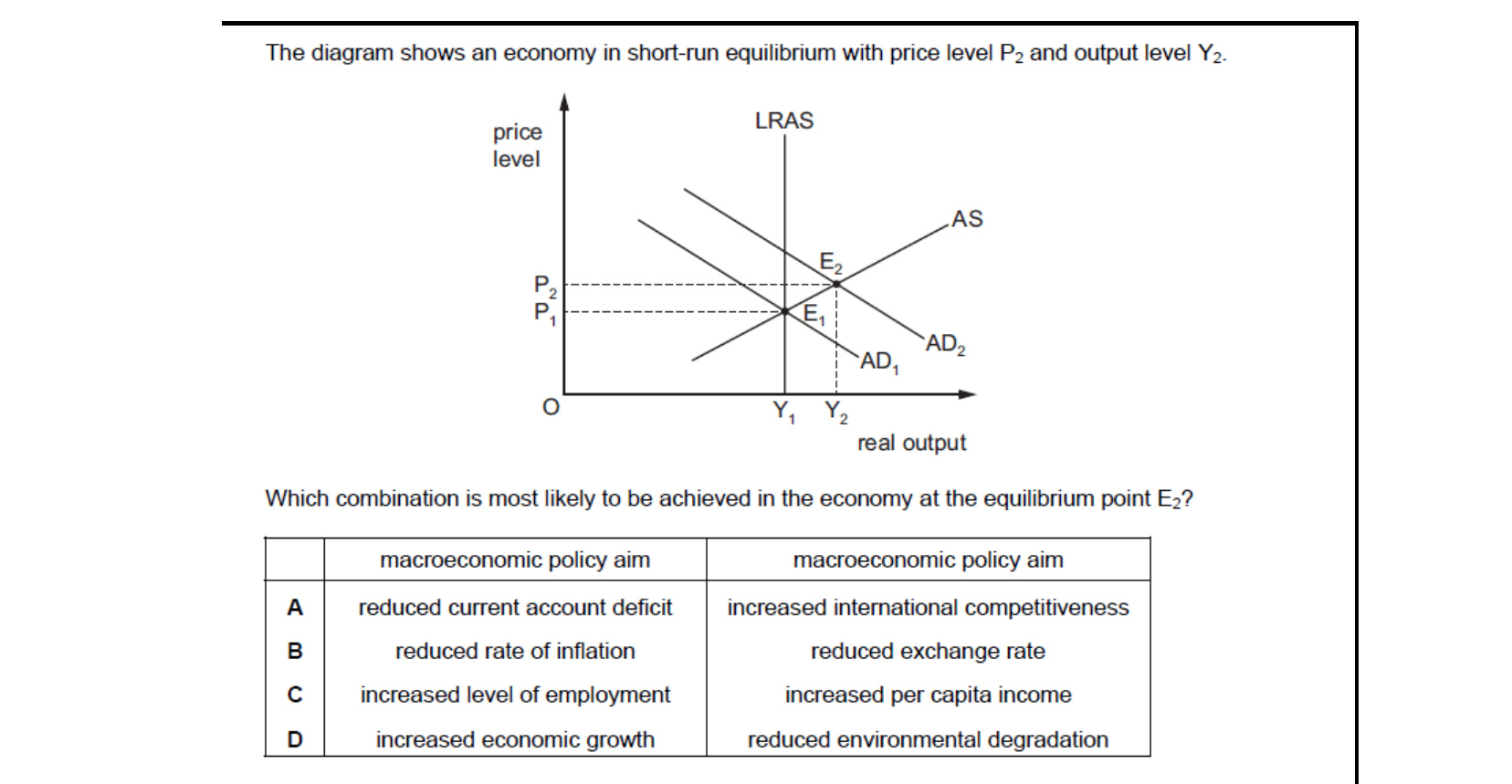
At E2 output is above Y1, so employment has risen; with more people earning income and producing output, real GDP per head also rises. The other pairs contain a conflict: a reduced deficit usually needs improved competitiveness rather than the demand expansion shown, lower inflation rarely coincides with a weaker exchange rate here, and rapid growth typically raises environmental pressure. So C is internally consistent.
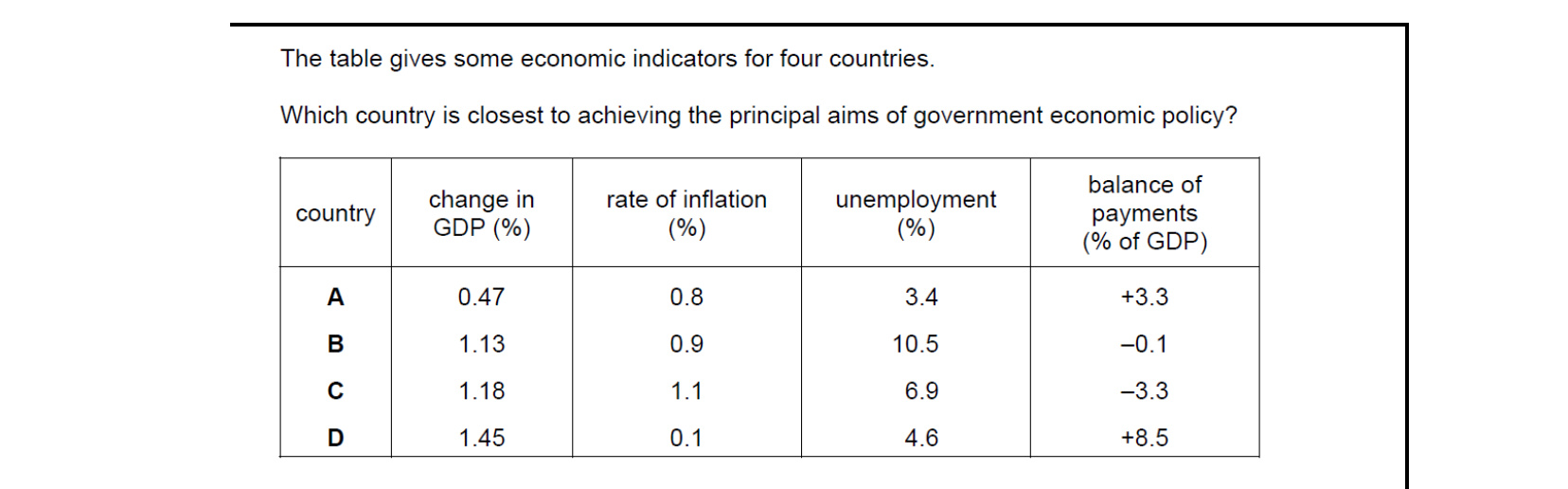
Judged against the four principal aims (growth, low inflation, low unemployment, BoP balance), country D performs best on all four: fastest GDP growth (1.45%), lowest inflation (0.1%), lowest unemployment (4.6%) and the largest BoP surplus (+8.5% of GDP). The other countries fail on at least one indicator, so D is closest to achieving the principal aims of policy.
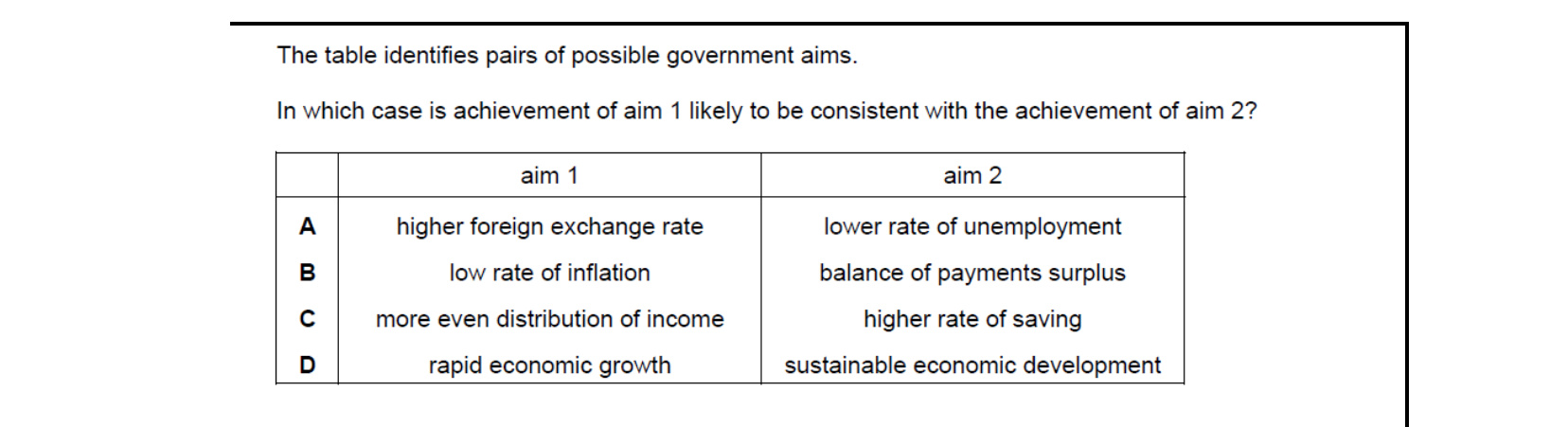
Low inflation keeps domestic goods price-competitive abroad and restrains import demand, both of which support a balance of payments surplus, so these two aims reinforce one another. A higher exchange rate worsens unemployment, redistribution can lower saving, and rapid growth often conflicts with sustainability — so only pairing B is mutually consistent.

High growth raises aggregate demand and the derived demand for labour, pulling unemployment down — the two aims naturally move together. The other combinations conflict in the short run: rapid growth tends to push prices up, lower unemployment fuels wage-led inflation, and a trade surplus often requires demand restraint that raises unemployment. So B is the complementary pair.
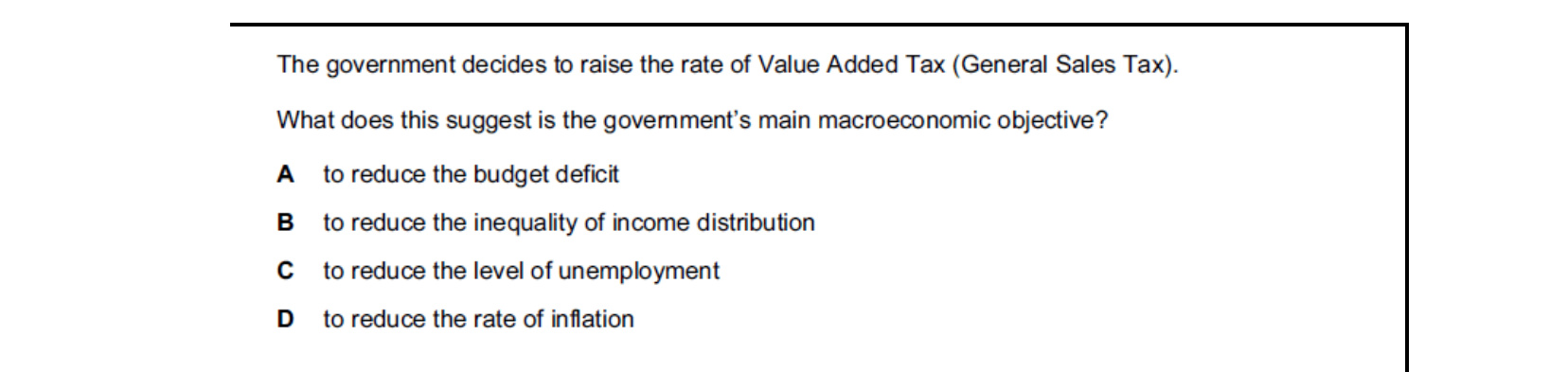
VAT (a general sales tax) is a broad indirect tax: raising it widens the tax base and increases government revenue, which directly shrinks any gap between spending and tax receipts. So the move signals that the chief aim is to reduce the budget deficit. It actually worsens inequality (VAT is regressive), depresses consumption (raising unemployment), and pushes the price level up rather than down.
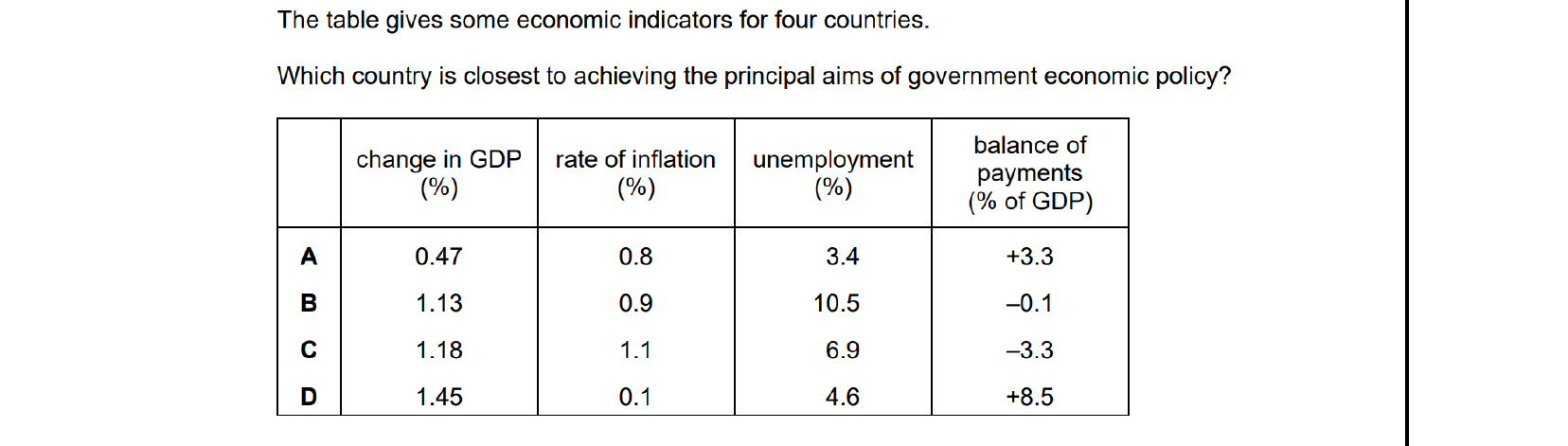
The four principal macro aims are high growth, low inflation, low unemployment and a healthy balance of payments. Country D scores best on every front: the highest GDP growth (1.45%), the lowest inflation (0.1%), low unemployment (4.6%) and a sizeable BoP surplus (+8.5% of GDP). The others each fail on at least one indicator, so D is closest to achieving all aims simultaneously.

A government macroeconomic aim must be a target for the whole economy. A fall in the general price level of goods and services is a macroeconomic target (price stability/low inflation). Monopoly regulation, taxes on specific goods and a minimum wage for one industry are microeconomic interventions affecting particular markets, not aggregate variables, so A is the only genuinely macro aim.
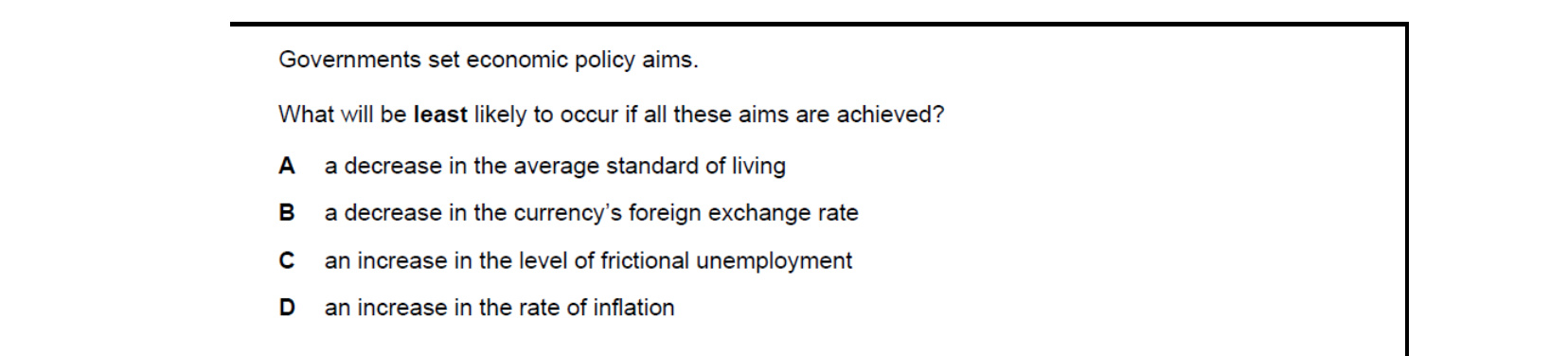
If growth, full employment, price stability and external balance are all met, frictional unemployment (workers briefly between jobs) still exists because labour markets always have some search activity — it is the natural floor of unemployment. A rising standard of living, stable currency and low inflation are all consistent with success, so the least likely outcome is a decrease in the average standard of living.
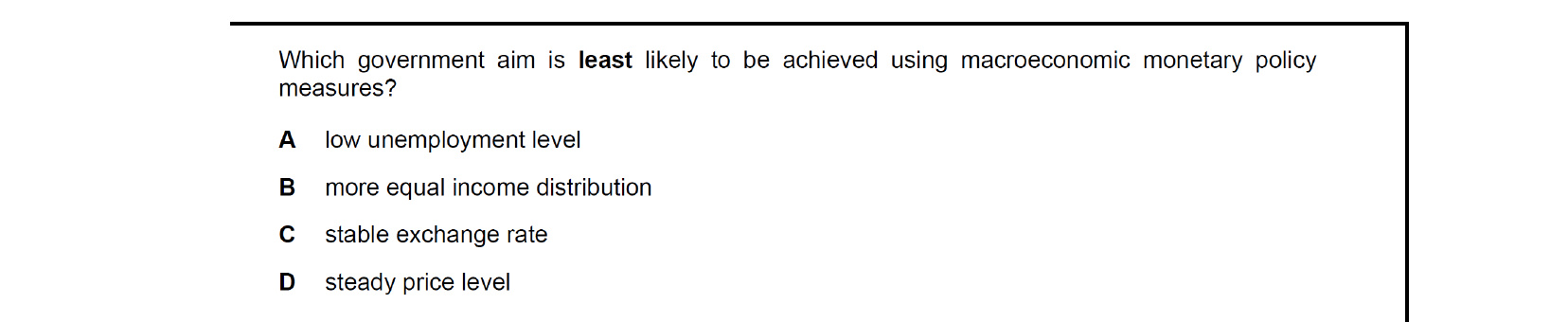
Monetary policy works through interest rates, credit and the money supply, so it can influence aggregate demand (affecting unemployment, the exchange rate and the price level). It cannot directly reshape who earns what — income distribution depends on tax-and-benefit (fiscal) policy and labour-market measures. Therefore a more equal income distribution is least likely to be achieved using monetary policy.
Attempt the practice questions above to build your score.
Self-evaluation checklist
After studying this chapter, you should be able to:
- Analyse macroeconomic policy objectives that aim to maintain a low and stable rate of inflation.
- Analyse macroeconomic policy objectives that aim to achieve balance of payments stability.
- Analyse macroeconomic policy objectives that aim to keep unemployment low and of short duration.
- Analyse macroeconomic policy objectives that aim for economic growth or an increase in the economic growth rate.
- Analyse macroeconomic policy objectives that aim to achieve sustainable development.
- Analyse macroeconomic policy objectives that aim to redistribute income and wealth from the rich to people on low incomes.
Want more practice? Drill this chapter's past-paper MCQs (14 questions) →